
Manhood
Medium
Etching
Dimensions
image: 9 7/16 x 6 3/16 in. (23.9 x 15.7 cm), trimmed to image
Classification
Prints
Department
Drawings and Prints
Museum
Metropolitan Museum of Art, New York, NY
Credit
The Elisha Whittelsey Collection, The Elisha Whittelsey Fund, 1962
Accession Number
62.600.30
Rights
Public Domain
Tags
Art Historical Context
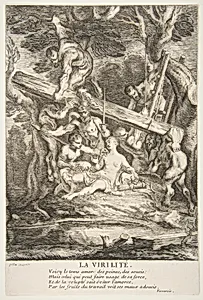
"Manhood" is a etching attributed to Claude Gillot and François Joullain, two prominent French artists of the early 18th century.ot, a painter and engraver known for his lively scenes and influence on the Rococo style—mentoring Antoine Watteau—likely provided the design, while Jouain, a skilled printmaker, executed the. Created around this transitional period from Baroque to Rococo, the undated work captures the era's fascination with the human form, blending classical influences with emerging decorative elegance. The image, trimmed to its precise dimensions of 9 7/16 x 6 3/16 inches, features male and female nudes engaged in labor, evoking themes of physical prowess and vitality—fitting its bold title. Etching's technique, using acid to etch intricate lines into a metal plate, allowed for the fluid, expressive contours that highlight muscular anatomy and dynamic poses, a hallmark of period printmaking that made fine art accessible beyond paintings. Housed in the Metropolitan Museum of Art's Drawings and Prints department through The Elisha Whittelsey Collection, this piece exemplifies how prints democratized nudes, once reserved for elite academies. It invites visitors to ponder the cultural celebration of the body in work and manhood during France's artistic golden age.
About the Artist
Claude Gillot|François Joullain · 1673–1722
Artist known for his elegant designs done in the Rococo manner of Audran; also for his predilection for scenes from the 'comedia dell'arte.' Few paintings survive; his work is known mainly through drawings and etchings. Comment on works: Genre; History