
Mantle Clock
c. 1937
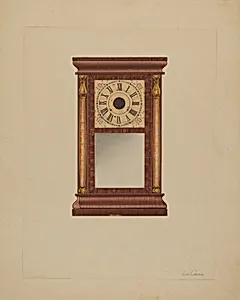
Medium
watercolor, colored pencil, graphite, and some heightening on paperboard
Dimensions
overall: 30.5 x 24.7 cm (12 x 9 3/4 in.) Original IAD Object: 25"high x 15"wide
Classification
Index of American Design
Department
CG-W
Museum
National Gallery of Art, Washington, D.C.
Credit
Index of American Design
Accession Number
1943.8.4810
Rights
Public Domain
Art Historical Context
Behold the exquisite *Mantle Clock*, a meticulously rendered depiction by artist Lon Cronk around 1937. This watercolor, colored pencil, graphite, and heightening on paperboard (30.5 x 24.7 cm) captures the elegance of an original American mantle clock measuring 25 inches high by 15 inches wide. Housed in the National Gallery of Art's Index of American Design collection, it showcases Cronk's skill in translating three-dimensional craftsmanship into a vibrant, two-dimensional study. Created as part of the Federal Art Project under the Works Progress Administration (WPA) during the Great Depression, the Index of American Design (1935–1942) employed artists like Cronk to document everyday American decorative arts—from folk objects to industrial designs. This initiative preserved cultural heritage amid economic hardship, celebrating the ingenuity of American makers through over 18,000 precise renderings. Cronk's technique blends fluid watercolor washes for rich tones, precise colored pencil and graphite for intricate details like clock faces and ornate casings, and subtle heightening for lifelike depth. Such methods highlight the clock's functional beauty, underscoring the IAD's mission to elevate vernacular design as fine art and inspire appreciation for America's crafted legacy.
About the Artist
Lon Cronk · 1855–present
Lon Cronk remains one of the more elusive figures in the broader history of art, with biographical records offering little concrete detail about his life, training, or national background. The limited documentation surrounding his career makes it difficult to situate him within a specific movement or tradition, though works attributed to him suggest a practitioner of some technical competence. Wh...