
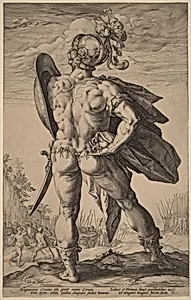
Marcus Valerius Corvus
1586
Medium
engraving
Classification
Department
CG-E
Museum
National Gallery of Art, Washington, D.C.
Credit
Rosenwald Collection
Accession Number
1943.3.4653
Rights
Public Domain
Art Historical Context
**Marcus Valerius Cor** is a striking 1586 engraving by Goltzius, the renowned Dutch Mannerist artist from Haarlem (1558–1617). This print, part of the National Gallery of Art's Rosen Collection, depicts the legendary Roman consul Marcus Valerius Corvusc. 370–270 BC), a hero famed in ancient lore for his victory over a giant Gaul, aided by a raven that perched on his helmet and attacked the foe—earning him the epithet "Corvus" (Latin for crow). Goltzius, a master engraver, showcases his innovative "swelling line" technique here, where lines vary dramatically in thickness to create a painterly depth and three-dimensionality unprecedented in prints. This Mannerist style, blending Northern Renaissance precision with Italianate elegance, made his engravings highly prized collectibles, spreading classical ideals across Europe during a time of renewed interest in antiquity amid the Dutch Golden Age. As a fine example of 16th-century printmaking, this work highlights engraving's role in democratizing art and history. Goltzius' virtuoso burin work captures Corvus in dynamic armor, evoking Roman valor and inviting viewers to ponder timeless tales of courage and divine favor. A gem for print enthusiasts! (198 words)
About the Artist
Hendrik Goltzius
Hendrick Goltzius (1558–1617), born near Viersen in the Duchy of Jülich (modern Germany), emerged as the preeminent Dutch engraver of the Northern Mannerist era. From a lineage of artists—his great-grandfather and grandfather were painters in Venlo, and his father, Jan Goltz II, a glass painter—Goltzius began his training under his father in painting on glass. A childhood fire severely deformed hi...