
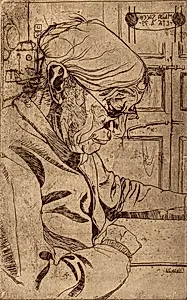
Maria Sacchi Reading
1907
Medium
Drypoint
Dimensions
19 in. × 12 5/8 in. (48.3 × 32.1 cm)
Classification
Prints
Department
Modern and Contemporary Art
Museum
Metropolitan Museum of Art, New York, NY
Credit
Bequest of Lydia Winston Malbin, 1989
Accession Number
1990.38.33
Rights
Public Domain
Tags
Art Historical Context
**Maria Sacchi Reading**1907) is an intimate drypoint print by Umberto Boccioni, the artist who would later become a cornerstone of Futurism. Created when Boccioni was just 25, this work captures a woman in profile, absorbed in reading, her face softly illuminated against a dark background. Measuring 19 × 12⅝ inches, it exemplifies early 20th-century experimentation in printmaking, housed today in the Metropolitan Museum of Art's Modern and Contemporary department through the bequest of Lydia Winston Mal. Drypoint, Boccioni's chosen medium, involves scratching directly into a metal plate with a sharp tool, producing rich, velvety lines with a tactile burr that adds emotional depth—ideal for portraying quiet introspection. This technique, rooted in 19th-century traditions, allowed Boccioni to blend precision with spontaneity, foreshadowing his dynamic Futurist style that exploded dynamism and motion after 1909. Though predating Futurism's manifesto, the print reflects Boccioni's Divisionist influences from his Milanese training, where light and form fragmented to evoke inner life. Maria Sacchi, likely a personal acquaintance, embodies the era's fascination with women's private moments, offering visitors a glimpse into the artist's evolution from contemplative portraits to revolutionary visions of modern speed.
About the Artist
Umberto Boccioni · 1882–1916
Umberto Boccioni (1882–1916) was an Italian painter and sculptor who became the leading artist and principal theorist of the Futurist movement. Born in Reggio Calabria, he studied in Rome under the Divisionist painter Giacomo Balla and was deeply influenced by Post-Impressionism before encountering the ideas of Filippo Tommaso Marinetti, whose 1909 Futurist Manifesto catalyzed Boccioni's artistic ...