
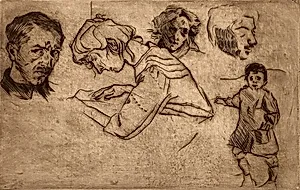
Sheet of Studies with Five Portraits
1909
Medium
Drypoint
Dimensions
14 3/4 × 19 3/4 in. (37.5 × 50.2 cm)
Classification
Prints
Department
Modern and Contemporary Art
Museum
Metropolitan Museum of Art, New York, NY
Credit
Bequest of Lydia Winston Malbin, 1989
Accession Number
1990.38.37
Rights
Public Domain
Tags
Art Historical Context
In the Modern and Contemporary Art department of the Metropolitan Museum of Art, Boccioni's *Sheet of Studies with Fiveraits* (1909) offers a captivating glimpse into the artist's exploratory process. Created in drypoint—a direct intaglio technique where a sharp needle scratches the metal plate to produce rich, velvety lines 14 3/4 × 19 3/4 in. sheet captures five intimate portraits, including profiles of boys, men and women. The bequest of Lydia Winston Malbin in 1989 brought this print to the museum's collection. Boccioni, a leading Italian artist on the cusp of Futurism, produced this work during a pivotal transitional phase, just before the 1910 Futurist Manifesto revolutionized modern art with its emphasis on dynamism and speed. Here, the studies reflect his earlier influences from Divisionism and Symbolism, showcasing fluid, expressive lines that hint at the fragmented forms he would later pioneer. Drypoint's spontaneity suited such sketches, allowing rapid mark-making without etching acid, resulting in a tactile immediacy prized by collectors. These portraits, with their varied gazes and poses, reveal Boccioni's fascination with human character and psychology. As preparatory drawings compiled on one sheet, they underscore the artist's iterative method, bridging traditional portraiture with the innovative energy that defined Futurism. A must-see for visitors tracing the roots of 20th-century modernism!
About the Artist
Umberto Boccioni · 1882–1916
Umberto Boccioni (1882–1916) was an Italian painter and sculptor who became the leading artist and principal theorist of the Futurist movement. Born in Reggio Calabria, he studied in Rome under the Divisionist painter Giacomo Balla and was deeply influenced by Post-Impressionism before encountering the ideas of Filippo Tommaso Marinetti, whose 1909 Futurist Manifesto catalyzed Boccioni's artistic ...