
Mashrabiyya Screen
Unknown Artist
15th–16th century
Medium
Wood; turned
Dimensions
H. 72 3/4 in. (184.8 cm) W. 72 1/2 in. (184.2 cm) D. 2 1/8 in. (5.4 cm)
Classification
Wood
Department
Islamic Art
Museum
Metropolitan Museum of Art, New York, NY
Credit
Gift of S.S. Howland, 1910
Accession Number
11.86.9
Rights
Public Domain
Tags
Art Historical Context
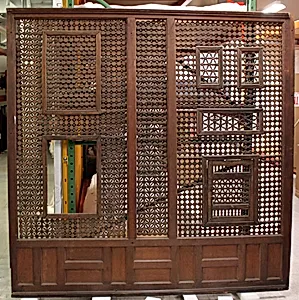
Step into the intricate world of Islamic architecture with stunning *Mashrabiyya* from the 15th–16th century. Crafted by an unknown artist, this large wooden panel—measuring nearly six feet square yet just over two inches deep—was designed as a lattice screen, a hallmark of Mamluk craftsmanship likely from Egypt or the broader Islamic world. Now housed in the Metropolitan Museum Art's Department of Islamic Art, it was generously gifted by S.S. Howland in 1910. The screen's medium of turned wood showcases masterful lathe work, where slender spindles and balusters were precisely shaped and interwoven into hypnotic geometric patterns. These motifs, repeating stars, crosses, and interlocking arches, exemplify the Islamic aversion to figurative imagery in favor of abstract mathematical beauty, symbolizing divine order and infinity. Such techniques demanded exceptional skill, as the wood was turned on a lathe to create uniform, delicate elements that interlock without nails. Culturally, mashrabiyya screens served vital practical roles in traditional homes and mosques: they filtered harsh sunlight, ensured privacy for women while allowing cool breezes and outward views, and added poetic ventilation. This artifact transports visitors to bustling medieval bazaars and serene harems, highlighting the fusion of utility, artistry, and spirituality in Islamic design.