
Mashrabiyya Screen
Unknown Artist
15th–16th century
Medium
Wood; turned
Dimensions
H. 140 in. (355.6 cm) W. 144 in. (365.8 cm) D. 1 1/4 in. (3.2 cm)
Classification
Wood
Department
Islamic Art
Museum
Metropolitan Museum of Art, New York, NY
Credit
Gift of S.S. Howland, 1910
Accession Number
11.86.4
Rights
Public Domain
Tags
Art Historical Context
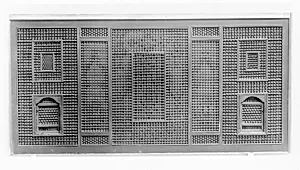
Step into the intricate world of Islamic architecture with this stunning *Mashrabiyya*, a masterful example of 15th–16th century woodwork from the Islamic world, likely Egypt during the Mamluk period Crafted from turned wood, this enormous screen—measuring over 11 feet tall and 12 feet wide yet just 1.25 inches deep—originally served as a lattice window or room divider. Its delicate, projecting design allowed air and light to filter through while preserving privacy, a clever fusion of form and function emblematic of traditional Middle Eastern homes and mosques. The artistry lies in the turned wood technique, where lathes shaped slender balusters and geometric motifs into a mesmerizing lattice. This method highlights the virtuosity of anonymous Islamic craftsmen, who wove complex star patterns and interlocking forms without nails or glue, showcasing mathematical precision and ornamental restraint rooted in Islamic aniconism. Such screens not only cooled interiors by shading sunlight but also symbolized hospitality and seclusion for women. Now a cherished highlight in the Metropolitan Museum of Art's Islamic Art Department—gifted by S.S. Howland in 1910—this screen invites visitors to ponder the everyday elegance of medieval Islamic life, where beauty enhanced utility.