
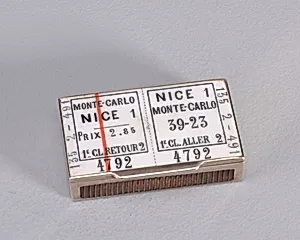
Matchsafe Depicting Train Ticket and View of Monte Carlo
late 19th century
Classification
containers
Department
Smithsonian Collection
Museum
Smithsonian American Art Museum
Credit
Gift of Stephen W. Brener and Carol B. Brener
Accession Number
1978-146-255
Rights
Public Domain
About this artwork
Research in Progress
Art Historical Context
This charming matchsafe, dating to the late 19th century captures the era's fascination with travel and glamour through its depiction of a train ticket and scenic view of Monte Carlo. As a small, portable container designed to safely hold matches—essential before the advent of safety matches—these objects were both functional and finely crafted, often serving as miniature canvases for intricate designs. Though the artist and exact medium remain unknown, its presence in the Smithsonian American Art's collection highlights everyday artifacts elevated to art through decorative appeal. Monte Carlo, the glittering playground of Europe's elite in the Belle Époque, symbolized luxury, casinos, and seaside escapism, made accessible by expanding rail networks. The train ticket motif evokes the excitement of grand tours, when affluent travelers jetted off via steam locomotives to the French Riviera. This matchsafe likely reflects that cultural zeitgeist, blending whimsy with wanderlust in a compact form. A gift from collectors Stephen W. Brener and Carol B. Brener, it joins the Smithsonian's diverse holdings of containers, underscoring how ordinary items from the Gilded Age preserve stories of innovation and leisure. Research continues to uncover more about its creation, inviting us to ponder the hidden artistry in history's pockets.
About the Artist
Unknown
The artist designated as "Unknown" in our virtual museum's collection exemplifies a poignant chapter in art history: creators whose identities have faded into obscurity despite the enduring power of their work. With only one known artwork attributed to them in our holdings, this figure represents countless anonymous hands that shaped visual culture across centuries. Museums worldwide, including th...