
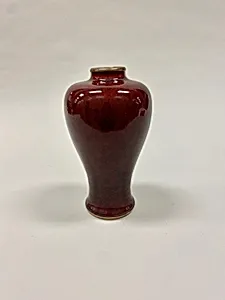
Meiping vase
Unknown Artist
late 17th–early 18th century
Medium
Porcelain with copper red glaze (Jingdezhen ware), copper mouth rim
Dimensions
H. 7 in. (17.8 cm); Diam. 4 in. (10.2 cm)
Classification
Ceramics
Culture & Period
China · Qing dynasty (1644–1911), Kangxi period (1662–1722)
Department
Asian Art
Museum
Metropolitan Museum of Art, New York, NY
Credit
Bequest of Benjamin Altman, 1913
Accession Number
14.40.47
Rights
Public Domain
Art Historical Context
This elegant Meiping vase, crafted in China's Jingdezhen kilns during the late 17th to early 18th century exemplifies the pinnacle of Qing dynasty porcelain artistry under the Kangxi emperor (r. 1662–1722). Standing just 7 inches tall, its pear-shaped form—narrow neck flaring to a wide base—is a classic meiping design, traditionally used to display single branches of plum blossoms, symbolizing resilience and renewal in Chinese culture. Produced at the imperial kilns of Jingdezhen, the world's porcelain capital, such vessels were prized for their technical mastery and refined aesthetics. The vase's standout feature is its copper red glaze, a challenging "sang de boeuf" effect achieved through precise control of copper oxide in the kiln's reducing atmosphere, yielding a deep, oxblood hue that shifts from crimson to purplish tones. A copper rim reinforces the mouth, adding durability and subtle contrast. This Kangxi-period innovation revived Ming dynasty techniques, marking a renaissance in monochrome glazes that influenced global ceramics. Bequeathed to the Metropolitan Museum of Art by Benjamin Altman in 1913, this petite treasure invites visitors to marvel at the Qing era's fusion of artistry and imperial ambition, where everyday forms became emblems of cultural sophistication.