
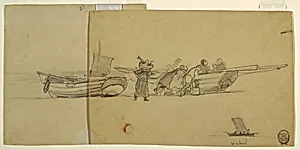
Men and Women Unloading a Fishing Dory, Cullercoats, England
Classification
seascapes
Department
Smithsonian Collection
Museum
Smithsonian American Art Museum
Credit
Gift of Charles Savage Homer, Jr.
Accession Number
1912-12-19
Rights
Public Domain
About this artwork
Research in Progress
Art Historical Context
Winslow Homer, a towering figure in American Realism, captured the rugged beauty of coastal life in *Men and Women Unloading Fishing Dory, Ccoats, England* (1881–82). This seascape depicts hardy fisherfolk—men and women working together to unload their small boat amid the North Sea's relentless waves, showcasing Homer's fascination with human resilience against nature's power. In 1881, Homer traveled to the fishing village of Cullerco, near Newcastle upon Tyne, England, seeking fresh inspiration after personal losses. He immersed himself in the community, painting the fisherwomen known for their strength and independence as they mended nets and launched dories into stormy waters. This period marked a pivotal shift in his oeuvre, blending American grit with European influences, and producing some of his most poignant marine scenes. Homer's masterful handling of light, color, and composition—hallmarks of his realist style—evokes the drama of everyday labor. Donated by his nephew Charles Savage Homer, Jr., to the Smithsonian American Art Museum, this work highlights the artist's enduring legacy in celebrating ordinary heroes of the sea. (178 words)