
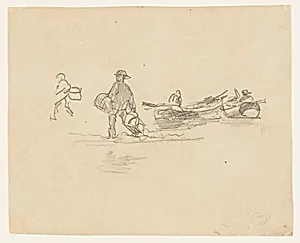
Two Fishermen, England
Classification
seascapes
Department
Smithsonian Collection
Museum
Smithsonian American Art Museum
Credit
Gift of Charles Savage Homer, Jr.
Accession Number
1912-12-220
Rights
Public Domain
About this artwork
Research in Progress
Art Historical Context
Winslow Homer, a towering figure in American Realism (1836–1910), painted *Two Fishermen, England* during pivotal stay in Tynemouth, England, from 1881–82. Fresh from the American Civil War's scars and Maine's coasts, Homer immersed himself in the North Sea's harsh beauty, drawing inspiration from local fishermen battling relentless waves. This seascape reflects his evolving fascination with the sea's power and human endurance, marking a bridge between his early illustrations and later monumental watercolors. Homer's style—marked by unflinching realism, dramatic light, and economical composition—brings these two figures to life amid turbulent waters, symbolizing quiet heroism. As a master of marine subjects, he captured nature's indifference with psychological depth, influencing generations of American artists. Though the medium awaits further research, its classification underscores Homer's signature focus on coastal labor. Today, gifted to the Smithsonian American Art Museum by Homer's brother, Charles Savage Homer, Jr., this work invites visitors to feel the salt spray and ponder the timeless dialogue between man and ocean.