
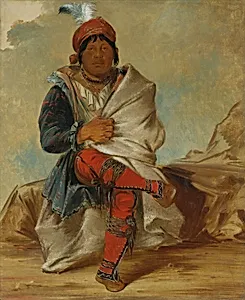
Mick-e-no-páh, Chief of the Tribe
1838
Medium
Painting
Classification
Painting
Department
Smithsonian Collection
Museum
Smithsonian American Art Museum
Credit
Smithsonian American Art Museum, Gift of Mrs. Joseph Harrison, Jr.
Accession Number
1985.66.300
Rights
Public Domain
Tags
About this artwork
George Catlin painted Mick-e-no-páh at Fort Moultrie, Charleston, South Carolina, in January 1838. He wrote of the Seminole chief: “Mick-e-no-pah is the head chief of the tribe, and a very lusty and dignified man. He took great pleasure in being present every day in my room, whilst I was painting the others; but positively refused to be painted, until he found that a bottle of whiskey, and another of wine, which I kept on my mantelpiece . . . were only to deal out their occasional kindnesses to ...
Art Historical Context
George Catlin's *ick-e-no-páh Chief of the Tribe* (1838) captures the Seminole leader in a full-length portrait painted at Fort Moultrie, Carolina, amid the turmoil of the Second Seminole (1835–1842). Catlin, a pioneering 19th-century artist dedicated to documenting Native American life cultural erasure, portrayed Mick-e-no-páh—alusty and dignified" chief—as he sat cross-legged, proudly displaying his red leggings. This oil painting exemplifies Catlin's realistic style, blending ethnographic accuracy with Romantic admiration for indigenous nobility. The artwork's creation tells a vivid story: Mick-e-no-páh initially refused to pose, watching others receive whiskey and wine as incentives. He relented only after insisting Catlin prove his skill by first painting his legs "fairly," starting from the canvas's lower edge. Catlin noted the chief's prosperity before the war, owning 100 enslaved people and cultivating corn and cotton, highlighting Seminole agricultural prowess and complex socio-economic ties in Florida. Displayed in the Smithsonian American Art Museum, this piece underscores the Seminoles' resistance to U.S. removal policies and Catlin's urgent mission to preserve vanishing cultures through portraiture, offering visitors a poignant window into pre-war Native leadership.
About the Artist
George Catlin · 1796–1872
George Catlin (1796–1872), born in Wilkes-Barre, Pennsylvania, to Putnam Catlin and Polly Sutton—who had been captured by Native Americans during the 1778 Battle of Wyoming—initially pursued a legal career. Trained at Litchfield Law School, he was admitted to the bar in 1819 but abandoned law after two years to study art in Philadelphia in 1823. Self-taught as a portraitist, Catlin quickly gained ...