
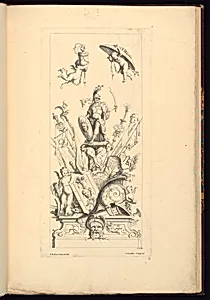
Military Ornament Design
Classification
Department
Smithsonian Collection
Museum
Smithsonian American Art Museum
Credit
Purchased for the Museum by the Advisory Council
Accession Number
1921-6-411-18
Rights
Public Domain
About this artwork
Research in Progress
Art Historical Context
**Military Ornament Design** *Jean-Bernard Turreau (French, 1672–1731), 1716* Print; Smithsonian American Art Museum in 1716 by French engraver Jean-Bernardreau, *Military Ornament Design* the ornate aesthetic of early 18th France during the Regency period following Louis XIV's death. Turreau, renowned for his intricate ornamental prints, likely crafted this work as a template for military regalia—think elaborate epaulettes, sword hilts, or uniform accents—reflecting the era's blend of grandeur and functional elegance amid post-War of the Spanish Succession reforms. As a print, the piece exemplifies the reproductive techniques of the time, such as etching or engraving, which allowed designers to disseminate precise patterns widely for artisans and military tailors. Its presence in the Smithsonian American Art Museum's collection, acquired through the Advisory Council, highlights cross-Atlantic appreciation for European decorative arts, bridging French craftsmanship with American curatorial interests. Though research continues, this design offers a window into how visual splendor bolstered national identity and martial pride.