
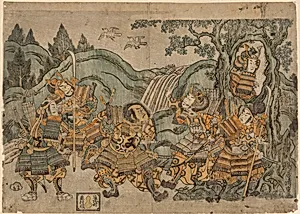
Minamoto no Yoritomo Hiding in a Tree
c. 1758
Medium
Color woodblock print, oban yoko-e, benizuri-e
Dimensions
44 × 31.2 cm (17 5/16 × 12 1/4 in.)
Classification
woodblock print
Department
Arts of Asia
Museum
Art Institute of Chicago
Accession Number
44129
Rights
Public Domain
Art Historical Context
In the vibrant world of 18th-century Japanese uyo-e, Torii Kiyoshige's *Minamoto no Yorit Hiding in a Tree* (c. 1758) captures a dramatic moment from samurai legend. The print depicts Minamoto no Yomo, the founder of Japan's first shogunate in 1185, evading enemies by concealing himself in a tree's branches during his flight after the Genpei War. This tale of resilience and cunning became a staple in popular storytelling, blending history with heroic folklore during the Edo period's cultural boom. Printed as a large horizontal oban yoko-e (44 × 31.2 cm) in the benizuri-e technique—a pioneering method using outline blocks plus a single pink/red tone for subtle color—Kiyoshige's work exemplifies the Torii school's theatrical flair. Known for kabuki posters and actor portraits, the Torii style infuses dynamic composition and bold lines here, heightening the tension of Yoritomo's perilous hideout amid watchful foes below. Housed in the Art Institute of Chicago's Arts of Asia collection, this woodblock print highlights ukiyo-e's role in democratizing art through affordable multiples. It reflects how Edo artists like Kiyoshige popularized warrior tales, bridging elite history with everyday entertainment and foreshadowing the full-color polychrome prints of masters like Hiroshige. A window into Japan's warrior ethos and printmaking innovation!