
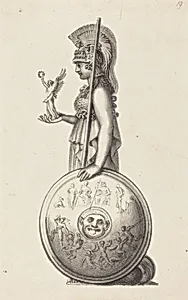
Minerva, by Phidas
published 1829
Medium
lithograph [proof before letters]
Classification
Department
CG-E
Museum
National Gallery of Art, Washington, D.C.
Credit
Rosenwald Collection
Accession Number
1980.45.1696
Rights
Public Domain
Art Historical Context
This lithograph, titled *Minerva, by Phidas*, captures the enduring fascination with classical antiquity in the early nineteenth century. Created by Maria Denman after a design by John Flaxman and published in 1829, the print reproduces an imagined representation of the ancient Greek sculptor Phidias’s celebrated statue of Athena (Minerva). Flaxman, a leading figure in the neoclassical movement, was renowned for his spare, linear drawings inspired by Greek vase painting and sculpture. Denman, his sister-in-law, translated these designs into lithography, a relatively new printmaking medium that allowed for wide circulation of classical imagery. As a proof before letters, this impression offers a rare glimpse into the printmaking process, showing the image prior to the addition of titles or inscriptions. Lithography’s smooth tonal qualities made it especially suited for reproducing the crisp contours and idealized forms that Flaxman admired in ancient art. Housed in the National Gallery of Art’s Rosenwald Collection, the work reflects the period’s enthusiasm for disseminating knowledge of classical masterpieces through affordable prints, enabling broader audiences to study and appreciate the artistic achievements of antiquity.