
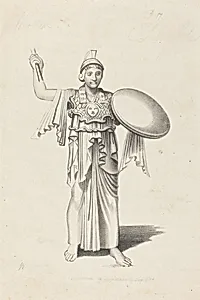
Minerva, From a Bronze by Daedalus
published 1829
Medium
lithograph [proof before letters]
Dimensions
sheet: 26.1 × 19 cm (10 1/4 × 7 1/2 in.)
Classification
Department
CG-E
Museum
National Gallery of Art, Washington, D.C.
Credit
Rosenwald Collection
Accession Number
1980.45.1694
Rights
Public Domain
Art Historical Context
This lithograph, published in 1829 by W. Walton after a design by John Flaxman, captures the goddess Minerva in a poised, classical stance. Created as a proof before letters—an early impression without added text—it reproduces a bronze sculpture traditionally attributed to the mythical Greek artisan Daedalus. The compact sheet, measuring just over 10 by 7 inches, exemplifies the early adoption of lithography, a medium then revolutionizing the reproduction of sculpture for wider audiences. John Flaxman, a leading figure in British neoclassicism, frequently drew inspiration from ancient sources to distill ideals of harmony and restraint. Here, his interpretation of the ancient bronze transforms the three-dimensional original into a refined two-dimensional image, highlighting Minerva’s serene authority and the crisp contours favored by neoclassical taste. Such prints played a vital role in disseminating classical imagery during the early nineteenth century, allowing scholars, artists, and the public to study revered antiquities without traveling to distant collections. Housed in the National Gallery of Art’s Rosenwald Collection, this work underscores the enduring dialogue between ancient myth, neoclassical revival, and the innovative printmaking techniques of its day.