
Model Reading
1910
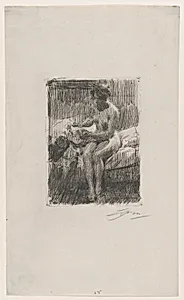
Medium
Etching; second state of two
Dimensions
Plate: 6 5/16 × 4 3/4 in. (16 × 12 cm) Sheet: 14 1/8 × 8 3/8 in. (35.8 × 21.3 cm)
Classification
Prints
Department
Drawings and Prints
Museum
Metropolitan Museum of Art, New York, NY
Credit
Harris Brisbane Dick Fund, 1917
Accession Number
17.3.698
Rights
Public Domain
Tags
Art Historical Context
Anders Zorn's *Model Reading* (1910) captures an intimate moment of a nude female model absorbed in a book, rendered in the delicate medium of etching. This second state of two impressions showcases Zorn's mastery as a Swedish printmaker (1860–1920), who rose to international fame for his luminous portraits and nudes. By 1910, Zorn was at the height of his career, blending precision with impressionistic light effects, often drawing from life models in his Paris and Stockholm studios. Etching allowed Zorn to achieve exquisite tonal gradations and subtle textures, evident in the model's soft contours, flowing hair, and the quiet play of light on her skin. The second state likely features refined details added after the initial proof, enhancing depth and atmosphere—a technique that made his prints highly sought after by collectors. Measuring just 6 5/16 × 4 3/4 inches on the plate, the work's small scale invites close viewing, emphasizing its technical brilliance. Acquired by The Metropolitan Museum of Art through the Harris Brisbane Dick Fund in 1917, *Model Reading* reflects early 20th-century fascination with the female form as both sensual and intellectual. Zorn's unidealized nudes challenged academic traditions, celebrating everyday grace and adding cultural depth through the motif of reading, symbolizing quiet contemplation amid modernity.
About the Artist
Anders Zorn · 1860–1920
Anders Zorn (1860–1920), one of Sweden's most celebrated artists, was born on February 18 in Utmeland near Mora in Dalarna, and raised on his maternal grandparents' farm in the nearby hamlet of Yvraden. Displaying prodigious talent from a young age, he attended school in Mora Strand until age twelve, followed by secondary grammar school in Enköping, where he excelled in drawing people and horses. ...