
Mont Sainte-Victoire
ca. 1902–6
Medium
Oil on canvas
Dimensions
22 1/2 x 38 1/4 in. (57.2 x 97.2 cm)
Classification
Paintings
Department
European Paintings
Museum
Metropolitan Museum of Art, New York, NY
Credit
The Walter H. and Leonore Annenberg Collection, Gift of Walter H. and Leonore Annenberg, 1994, Bequest of Walter H. Annenberg, 2002
Accession Number
1994.420
Rights
Public Domain
Tags
About this artwork
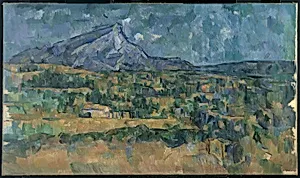
Mont Sainte-Victoire is an oil painting by French Post-Impressionist Paul Cézanne, created between 1902 and 1906 during the final years of his life. This work represents one of the grandest and most resolved of the artist's many depictions of the iconic Provençal mountain visible from his native Aix-en-Provence. The painting presents a panoramic view of the mountain and surrounding landscape rendered through Cézanne's characteristic geometric simplification and modulated color patches. The comp...
Art Historical Context
Paul Cézanne's *Mont Sainte-Victoire (ca. 1902–6), an oil on canvas now housed in the Metropolitan Museum of Art, captures the artist's lifelong obsession with the iconic mountain overlooking his hometown of Aix-en-Provence. As a cornerstone of Post-Impressionism, this panoramic landscape exemplifies Cézanne's final years, when he obsessively painted the peak eleven times in oil and countless times in watercolor. Working in his studio until his death, he enlarged the canvas to expand the foreground and right side, refining his vision over four years. The composition unfolds in rhythmic layers: lush green trees and fields in the foreground give way to houses and vegetation in the middle ground, culminating in the mountain's massive form against a glowing sky. Cézanne's signature geometric simplification—modulated color patches and interlocking planes—builds solidity and atmospheric shimmer through dense, layered brushstrokes, creating a tapestry of depth without traditional perspective. This "grandest and most resolved" version influenced Cubism and abstraction by prioritizing form and structure over mere representation. Donated through the Walter H. and Leonore Annenberg Collection, it invites visitors to witness the bridge between Impressionism and modernism. (198 words)
About the Artist
Paul Cézanne · 1839–1906
Paul Cézanne (1839-1906) stands as one of the most influential figures in the history of modern art, often called the "Father of Modern Art" for his revolutionary approach to form, color, and pictorial space. Born in Aix-en-Provence to a wealthy banker who discouraged artistic pursuits, Cézanne rejected a legal career to pursue painting, though he remained financially dependent on his family until...