
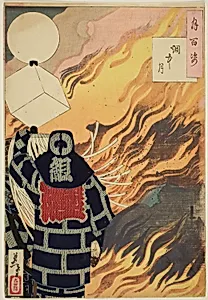
Moon and Smoke (Enchu no tsuki), from the series "One Hundred Aspects of the Moon (Tsuki hyaku sugata)"
Medium
Color woodblock print
Classification
woodblock print
Department
Arts of Asia
Museum
Art Institute of Chicago
Accession Number
197414
Rights
Public Domain
Art Historical Context
Tsukioka Yoshitoshi’s “Moon and Smoke (Enchu no tsuki)” belongs to his celebrated series “One Hundred Aspects of the Moon,” published between 1885 and 1892. A master of late ukiyo-e,itoshi blended traditional Japanese printmaking with dramatic lighting and psychological depth. Each design in the series pairs a moonlit scene with figures drawn from history, literature, and folklore, inviting viewers to contemplate fleeting moments of beauty and emotion. This color woodblock print exemplifies the technical sophistication of Meiji-era print production. Multiple carved blocks were inked separately and printed in precise registration to achieve rich gradients, delicate smoke effects, and luminous moonlight. The medium itself carried cultural weight: woodblock prints had long made art accessible to a broad public, and Yoshitoshi’s late works helped sustain the tradition even as photography and Western painting gained prominence in Japan. Created in 1886, the print reflects a period of rapid modernization while preserving poetic themes central to Japanese aesthetics. The interplay of moon and smoke evokes transience and mystery, encouraging quiet reflection on nature’s cycles and human experience. Today, the impression at the Art Institute of Chicago allows visitors to appreciate both Yoshitoshi’s artistic vision and the enduring appeal of ukiyo-e.
About the Artist
Tsukioka Yoshitoshi · 1839–1892
Tsukioka Yoshitoshi was born on April 30, 1839, in the Shimbashi district of Edo, the city that would become Tokyo. At the age of eleven he was apprenticed to Utagawa Kuniyoshi, one of the great masters of the Japanese woodblock print, who gave the boy the artist name 'Yoshitoshi' as a mark of lineage within the Utagawa School. From Kuniyoshi, Yoshitoshi absorbed the full tradition of ukiyo-e — th...