
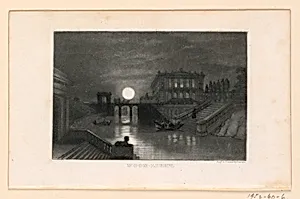
Moon-Light
Classification
Department
Smithsonian Collection
Museum
Smithsonian American Art Museum
Credit
Gift of Anonymous Donor
Accession Number
1952-60-6
Rights
Public Domain
About this artwork
Research in Progress
Art Historical Context
**Moon-Light**, created by John Sartain in 1847, captures the ethereal glow of a nocturnal scene through the artistry of one of19th-century America's foremost engravers. Born in London and active in Philadelphia, Sartain1808–1897) was a master of printmaking, particularly mezzotint—a technique he helped popularize in the U.S. Known for its rich tonal gradations, mezzotint allowed artists like Sartain to evoke dramatic lighting effects, making it ideal for moonlit subjects that blend shadow and subtle luminescence. This print reflects the Romantic era's fascination with nature's sublime beauty, where moonlight symbolized mystery and tranquility. As a key figure in American art circles, Sartain not only reproduced works by luminaries like Thomas Cole but also advanced engraving as a democratic medium, bringing fine art to wider audiences via affordable prints. Housed in the Smithsonian American Art Museum's collection through an anonymous gift, *Moon-Light* exemplifies mid-19th-century innovation in graphic arts. Though research continues, the work underscores Sartain's technical prowess and his role in elevating printmaking from mere reproduction to expressive storytelling, inviting viewers to ponder the quiet poetry of night. (178 words)