
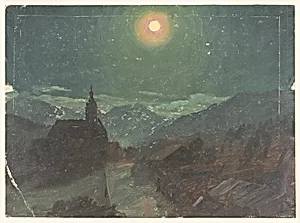
Moonlight over an Alpine Village
June - September, 1868
Classification
landscapes
Department
Smithsonian Collection
Museum
Smithsonian American Art Museum
Credit
Gift of Louis P. Church
Accession Number
1917-4-1369
Rights
Public Domain
About this artwork
Research in Progress
Art Historical Context
Frederic Edwin Church, a leading figure of the Hudson River School, the serene majesty of nature in *Moonlight over an Alpine Village (1868). Painted during the summer months of June to September, this landscape reflects Church's travels through Europe's majestic Alps, a departure from his more familiar American and South American vistas. As an American artist (1826–1900), Church was renowned for his romantic depictions of sublime wilderness, often infused with luminist techniques that emphasize dramatic light effects—like the ethereal glow of moonlight here—to evoke awe and spiritual transcendence. The painting exemplifies Church's meticulous attention to atmospheric detail, where soft lunar illumination bathes the alpine village in a dreamlike haze, contrasting sharp peaks and shadowed valleys. This work highlights his ability to blend precise observation with emotional resonance, a hallmark of 19th-century American landscape art that celebrated nature's grandeur amid rapid industrialization. Though the medium remains under study, its classification as a landscape underscores Church's enduring influence on environmental themes in art. Now part of the Smithsonian American Art Museum's collection—generously gifted by Louis P. Church—this piece invites visitors to ponder humanity's harmonious place within the cosmos, much like Church's grander canvases such as *Niagara* or *The Heart of the Andes*. Research continues to unveil more about its creation, adding to its allure.