
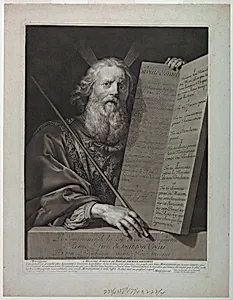
Moses
Classification
Department
Smithsonian Collection
Museum
Smithsonian American Art Museum
Credit
Gift of Milton Einstein
Accession Number
1959-49-8
Rights
Public Domain
About this artwork
Research in Progress
Art Historical Context
Robert Nanteuil (3–1678), one of France's foremost engravers during the Baroque era, created exquisitely detailed prints that the likenesses of royalty, nobility, and biblical figures with remarkable precision. His **, dated 1699—a posthum edition likely produced from his plates—exemplifies his mastery of engraving, a technique that allowed for intricate textures and subtle shading through fine incisions into copper plates. Though the specific medium remains under study, such prints were revolutionary for their time, bridging fine art and reproducible imagery. In the op court of Louis XIV, Nanteuil's work elevated printmaking from craft to high art, influencing generations of European artists. Depicting the prophet Moses, this piece draws on the era's fascination with classical and biblical themes, blending spiritual gravitas with technical virtuosity. Collectors prized his portraits for their lifelike depth, achieved through delicate cross-hatching and meticulous observation. Housed in the Smithsonian American Art Museum as a gift from Milton Einstein, *Moses* invites visitors to appreciate how 17th-century innovations in print technology democratized art, making profound imagery accessible beyond elite circles. Ongoing research promises to reveal more about its production, enriching our understanding of Nanteuil's enduring legacy.