
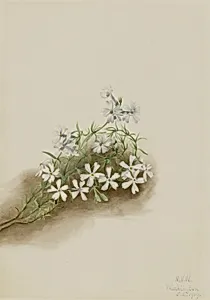
Moss Pink (Phlox subulate)
Medium
Painting
Classification
Painting
Department
Smithsonian Collection
Museum
Smithsonian American Art Museum
Credit
Smithsonian American Art Museum, Gift of the artist
Accession Number
1970.355.256
Rights
Public Domain
Tags
Art Historical Context
Mary Vaux Walcott'sMoss Pink (Phlox subulata)*, painted in 1919, the delicate beauty of this low-growing wildflower native to eastern North America. With its carpet-like mats of needle-like leaves and vibrant pink blooms in spring, moss pink—also known as creeping phlox—thrives in rocky, sandy soils, evoking the charm of alpine meadows and woodland edges. Walcott, a skilled artist and naturalist (1860–1940), rendered this specimen with precision, highlighting its botanical details in a style that bridges scientific illustration and fine art. As the wife of Smithsonian Secretary Charles Doolittle Walcott, Mary accompanied her husband on expeditions across the Rocky Mountains and beyond, where she sketched hundreds of wildflowers from life. Her works, including this painting gifted to the Smithsonian American Art Museum, contributed to the five-volume *North American Wild Flowers* (1924–1928), blending artistic elegance with scientific accuracy. This piece exemplifies early 20th-century botanical art, valued for its role in documenting America's flora during a time of growing environmental awareness. Today, *Moss Pink* invites visitors to appreciate Walcott's legacy as a pioneering woman in science and art, reminding us of nature's intricate wonders preserved through her keen eye.