
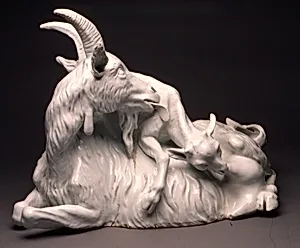
Mother goat and suckling kid
Medium
Hard-paste porcelain
Dimensions
Overall: 19 3/8 × 25 1/2 × 13 1/2 in. (49.2 × 64.8 × 34.3 cm)
Classification
Ceramics-Porcelain
Culture
German, Meissen
Department
European Sculpture and Decorative Arts
Museum
Metropolitan Museum of Art, New York, NY
Credit
Gift of Mrs. Jean Mauzé, 1962
Accession Number
62.245
Rights
Public Domain
Tags
Art Historical Context
Behold the enchanting *Mother Goat and Suckling Kid a masterful porcelain sculpture from the Meissen Manuf, modeled by Johann Joachim Känd around 1732. This German treasure, standing nearly two feet long, captures a tender moment in nature with remarkable lifelike detail— the mother goat protectively nuzzling her kid amid a rocky landscape. Crafted in hard-paste porcelain,issen's groundbreaking invention that rivaled China's imperial wares, it exemplifies early European mastery of this durable, translucent medium. Kändler, Meissen's brilliant chief modeler from the early 1730s, infused the piece with dynamic Rococo energy: flowing forms, textured fur, and expressive poses that bring the animals vividly to life. Produced during the factory's golden age under Augustus the Strong, such animal groups were prized by European nobility for lavish tableaus or cabinets, symbolizing the era's delight in naturalism and whimsy. At 19 3/8 × 25 1/2 × 13 1/2 inches, its scale underscores the technical bravura required to fire such ambitious pieces without flaw. Today, this gift to the Metropolitan Museum of Art invites us to marvel at 18th-century innovation, where porcelain became sculpture, blending artistry with alchemy. A perfect emblem of Meissen's enduring legacy in decorative arts.
About the Artist
Meissen Manufactory|Johann Joachim Kändler · 1710–present
The Meissen Manufactory, established on June 6, 1710, by Augustus the Strong, Elector of Saxony and King of Poland, marked the dawn of true hard-paste porcelain production in Europe. Nestled at Albrechtsburg Castle in Meissen near Dresden, the Royal Polish and Electoral Saxon Porcelain Manufactory arose from alchemical experiments begun in 1708 by physicist Ehrenfried Walther von Tschirnhaus and p...