
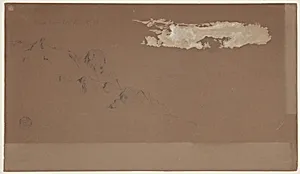
Mountains near Mocha, Ecuador
June 16, 1857
Classification
landscapes
Department
Smithsonian Collection
Museum
Smithsonian American Art Museum
Credit
Gift of Louis P. Church
Accession Number
1917-4-238
Rights
Public Domain
About this artwork
Research in Progress
Art Historical Context
Frederic Edwin Church, a leading figure of the Hudson River School, captured the majestic "Mountains near Mocha, Ecuador" on June 16, 1857, during his second expedition to South America. This landscape reflects Church's passion for documenting the sublime beauty of nature, inspired by explorer Alexander von Humboldt's scientific accounts of the Andes. Traveling through Ecuador in 1857, Church sketched directly from life amid volcanic peaks and lush valleys, blending meticulous observation with romantic grandeur to evoke awe at the continent's untamed wilderness. As a quintessential Hudson River School work, the painting exemplifies Church's luminist style—characterized by radiant light effects, precise details, and atmospheric depth—though its exact medium remains under study. These on-site studies fueled his monumental studio canvases, like *Cotopaxi* (1862), influencing American landscape art by merging science, spirituality, and national pride in the New World's wonders. Donated by his son Louis P. Church, it now graces the Smithsonian American Art Museum, offering a window into 19th-century exploration. Though research continues, this piece highlights Church's role in elevating landscapes as profound cultural icons, inviting visitors to ponder humanity's place amid nature's majesty.