
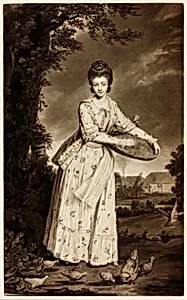
Mrs. Pelham Feeding Her Chickens
Medium
Mezzotint on cream wove paper
Dimensions
Image: 62 × 38.2 cm (24 7/16 × 15 1/16 in.); Plate: 62.1 × 38.5 cm (24 1/2 × 15 3/16 in.); Sheet: 65.5 × 42.5 cm (25 13/16 × 16 3/4 in.)
Classification
mezzotint
Department
Prints and Drawings
Museum
Art Institute of Chicago
Accession Number
27227
Rights
Public Domain
About this artwork
Printed after a 1770 Joshua Reynolds painting, this mezzotint features the 1st Baroness of Yarborough, Mrs. Sophia Pelham. Mrs. Pelham wears a workingclass–inspired yet finely embroidered Brunswick dress to feed her chickens before a rustic farmhouse. Such scenes are reminiscent of the 18th-century British fashion for ornamental farms and dairies within elite society, similar to Marie Antoinette’s 1783 Hamlet at Versailles, with its imported Swiss sheep and cows. In fact, Mrs. Pelham had her own...
Art Historical Context
Step into the serene world of 18th-century British printmaking with *Mrs. Pelham Feeding Her Chick*, a captivating mezzotint created by William Dickinson in 1775. This evocative image, housed in the Art Institute of Chicago's Prints Drawings Department, captures a moment of quiet domesticity on cream wove paper, measuring an impressive 62 × 38.2 cm for the image alone. Dickinson, a skilledaver of the Georgian era, specialized in mezzotints that brought painterly depth to affordable prints, making fine art accessible beyond elite circles. Mezzotint, often called the "dark manner," revolutionized printmaking with its velvety tones and subtle gradations. The technique begins with a specially textured copper plate rocked to hold dense black ink, then meticulously scraped and burnished by the artist to coax out lights and midtones—yielding a soft, luminous effect ideal for portraits and genre scenes like this pastoral vignette of Mrs. Pelham tending her flock. In 1775, amid Britain's flourishing print culture, such works celebrated genteel rural life, blending elegance with everyday charm. This piece exemplifies the mezzotint's golden age, bridging painting and reproduction while preserving the warmth of intimate moments. A delightful window into 18th-century sensibilities, it invites you to linger on its rich textures and timeless tranquility. (198 words)