
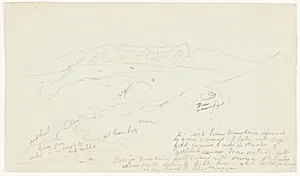
Mt. Sannine near Beirut, Lebanon
May 15, 1868
Classification
landscapes
Department
Smithsonian Collection
Museum
Smithsonian American Art Museum
Credit
Gift of Louis P. Church
Accession Number
1917-4-928
Rights
Public Domain
About this artwork
Research in Progress
Art Historical Context
Frederic Edwin Church, a leading figure in the Hudson River School of American landscape painting, created *Mt. Sannine near Beirut, Lebanon* on May 15, 1868, during his extensive travels through the Middle East. Known for his luminous, detailed depictions of nature's grandeur, Church ventured beyond American shores to capture the majestic peaks of Mount Sannine, a prominent feature in Lebanon's Anti-Lebanon range overlooking Beirut. This work reflects his lifelong fascination with exotic locales, blending romantic idealism with precise observation, much like his famed views of Niagara Falls or the Andes. As a landscape classification piece, it exemplifies Church's technique of evoking the sublime—nature's awe-inspiring power—through meticulous rendering of light, atmosphere, and topography. Dated to the very day of its execution, the artwork likely served as a field sketch or oil study, documenting his pilgrimage to the Holy Land amid a period of global exploration by 19th-century artists. Though the medium remains under research, it underscores Church's role in expanding American art's horizons. Today, housed in the Smithsonian American Art Museum as a gift from Church's son, Louis P. Church, this piece invites visitors to trace the artist's footsteps, connecting distant mountains to the evolving narrative of U.S. landscape tradition.