
Mucius Scaevola
Medium
engraving
Dimensions
104; 148
Rights
Public Domain
About this artwork
datum
Art Historical Context
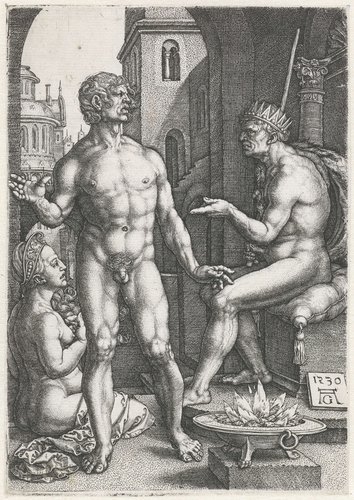
Behold *Mucius Scaevola* (1530), a masterful engraving by Heinrich Aldegrever, a prominent German artist of the Northern Renaissance. Measuring just 148 mm high by 104 mm wide, this intimate print captures the dramatic moment from ancient Roman legend when the hero Gaius Mucius Scaevola thrust his hand into a fire to prove his unyielding resolve after failing to assassinate the Etruscan king Porsenna. Aldegrever, one of the "Little Masters" celebrated for their exquisite small-scale works, renders the scene with remarkable precision, showcasing his skill as both engraver and goldsmith. Created during the early 16th century amid the Renaissance revival of classical antiquity, the artwork reflects humanism's fascination with stoic virtue and moral fortitude. Engraving, Aldegrever's specialty, involved incising fine lines into a metal plate to produce detailed, reproducible images—ideal for spreading humanist ideals across Europe through affordable prints. The technique allows for intricate shading and texture, evident in the flickering flames and expressive figures that draw viewers into the tale of sacrifice. This piece exemplifies the cultural bridge between antiquity and the Reformation era, inviting us to ponder timeless themes of courage. Aldegrever's output, including series on historical and biblical subjects, made classical stories accessible, influencing collectors and artists alike. A gem for any virtual gallery stroll! (198 words)
About the Artist
Heinrich Aldegrever · 1502–1561
Heinrich Aldegrever, born in 1502 in Paderborn, Westphalia, to parents Herman and Katherine Trippenmeker—a family of clog-makers known by the dialect name Trippenmecker—emerged as a multifaceted artist in the German Renaissance. His early training remains undocumented, though he likely apprenticed in a Soest goldsmith's workshop after relocating there around 1525, where he joined the painters' gui...