
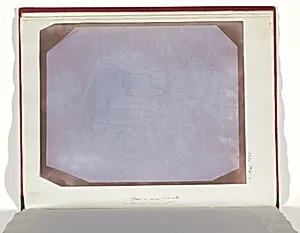
Muro a secco divoccato ad utensili campestri
Medium
Salted paper print from paper negative
Dimensions
Image: 17.2 x 21.2 cm (6 3/4 x 8 3/8 in.) Sheet: 18 x 22.6 cm (7 1/16 x 8 7/8 in.)
Classification
Photographs
Department
Photographs
Museum
Metropolitan Museum of Art, New York, NY
Credit
Harris Brisbane Dick Fund, 1936
Accession Number
36.37 (40)
Rights
Public Domain
Art Historical Context
William Henry Fox Talbot's *Muro a secco divoccato ad utensiliestri* (1840) captures a humble rural Italian scene: a dry stone wall partially dismantled to reveal rustic farm tools beneath. This salted paper print from a paper negative, measuring about 17 x 21 cm, exemplifies Talbot's pioneering work in photography just one year after the medium's public debut. Shot during his travels in Italy, it reflects his fascination with everyday textures—from weathered stone to everyday implements—transforming ordinary subjects into poetic studies of light and shadow. Talbot, a British inventor, developed the calotype process around 1839, using paper negatives to produce multiple positive prints like this one. Unlike the sharp, unique images of Daguerre's rival process, the salted paper print yields a soft, painterly quality with subtle tones, marking a shift toward photography as reproducible art. This technique allowed for greater creativity and laid groundwork for modern photography. Housed in the Metropolitan Museum of Art thanks to the Harris Brisbane Dick Fund (1936), the photograph highlights early 19th-century Europe's embrace of visual documentation. It invites us to marvel at Talbot's vision: turning a fleeting moment into an enduring record of rural life, bridging art and science in photography's infancy.
About the Artist
William Henry Fox Talbot · 1800–1877
William Henry Fox Talbot (1800–1877), a British polymath whose ingenuity transformed visual representation, was born on 11 February 1800 at Melbury House, Dorset, the only child of William Davenport Talbot of Lacock Abbey and Lady Elisabeth Fox Strangways, daughter of the 2nd Earl of Ilchester. His father died shortly after his birth, leaving the family in financial straits until his formidable mo...