
Musical Instruments for the Noh Dance
19th century
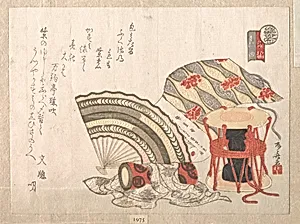
Medium
Woodblock print (surimono); ink and color on paper
Dimensions
5 3/4 x 6 7/8 in. (14.6 x 17.5 cm)
Classification
Prints
Culture & Period
Japan · Edo period (1615–1868)
Department
Asian Art
Museum
Metropolitan Museum of Art, New York, NY
Credit
H. O. Havemeyer Collection, Bequest of Mrs. H. O. Havemeyer, 1929
Accession Number
JP1975
Rights
Public Domain
Tags
Art Historical Context
Nestled in the Metropolitan Museum of Art's Asian Art collection, *Musical Instruments for theoh Dance* is a 19th-century woodblock print (surimono) by Ryūryūkyo Shinsai. Created during Japan's Edo period (16151868), this intimate measures just 5 3/4 x 6 7/8 inches, showcasing the refined artistry of ukiyo traditions. Surimono, or "printed things," were luxurious, privately commissioned prints often exchanged as New Year's gifts among literati, featuring vibrant inks, subtle colors, and sometimes embossed effects on fine paper. The print celebrates the rhythmic world of Noh theater, Japan's classical dance-drama form, by depicting essential musical instruments like flutes, drums, and gongs—tools that punctuate its haunting performances. Fans, another key motif, evoke the performers' graceful gestures, blending everyday elegance with sacred ritual. Shinsai, a master of surimono, captures these objects with exquisite detail and poise, highlighting Edo Japan's fascination with kabuki and Noh as cultural pinnacles. Part of the esteemed H. O. Havemeyer Collection, this gem invites visitors to appreciate how such prints preserved ephemeral traditions, bridging art, poetry, and performance in a fleeting, harmonious beauty.
About the Artist
Ryūryūkyo Shinsai · 1799–1823
Ryūryūkyo Shinsai (柳々居辰斎), active from 1799 to 1823, was a prominent Japanese ukiyo-e printmaker based in Edo (modern Tokyo), renowned for his mastery of surimono—luxurious, privately commissioned woodblock prints produced for elite poetry circles and New Year's celebrations. He began his training under Tawaraya Sōri before becoming a student of the legendary Katsushika Hokusai, from whom he recei...