
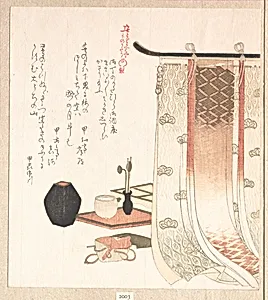
Screen and Utensils for the Incense Ceremony
19th century
Medium
Woodblock print (surimono); ink and color on paper
Dimensions
8 1/16 x 7 1/4 in. (20.5 x 18.4 cm)
Classification
Prints
Culture & Period
Japan · Edo period (1615–1868)
Department
Asian Art
Museum
Metropolitan Museum of Art, New York, NY
Credit
H. O. Havemeyer Collection, Bequest of Mrs. H. O. Havemeyer, 1929
Accession Number
JP2003
Rights
Public Domain
Tags
Art Historical Context
In the elegant world of Edo-period Japan (1615–1868), Kubo Shunman crafted this intimate woodblock print titled *Screen and Utens for the Incense Ceremony A master of surimono—luxurious, privately commissioned prints often produced for New Year's greetings or poetic gatherings—Shunman (1777–1845) blended ukiyo-e precision with poetic finesse. Created in the 19th century using and color on paper, small gem (8 1/16 x 7 1/4 in.) captures the refined tools of kōdō, the Japanese art of incense appreciation, evoking sensory rituals akin to the tea ceremony. The artwork depicts a folding screen and meticulously arranged utensils—incense burners, trays, and holders—symbols of sophistication among samurai, merchants, and literati. During the Edo era, kōdō flourished as a meditative practice rooted in Zen Buddhism, where participants discerned subtle fragrances like a game of poetic memory. Shunman's composition highlights the tactile beauty of these objects, their lacquered surfaces gleaming through vibrant colors and fine lines, underscoring the period's obsession with ephemeral beauty (mono no aware). This print, from the Metropolitan Museum of Art's H. O. Havemeyer Collection, exemplifies surimono's exclusivity: often limited editions with embossed textures or metallic pigments, they were treasures exchanged among elites. Shunman's dual role as poet and artist infuses it with cultural depth, inviting viewers to imagine the fragrant mists rising in a quiet tokonoma alcove.
About the Artist
Kubo Shunman · 1757–1820
Japanese, 1757–1820