
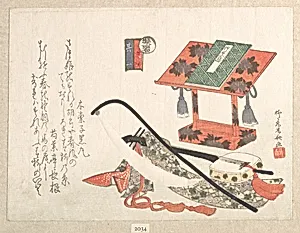
Instruments and Stand for Music
19th century
Medium
Woodblock print (surimono); ink and color on paper
Dimensions
5 11/16 x 7 9/16 in. (14.4 x 19.2 cm)
Classification
Prints
Culture & Period
Japan · Edo period (1615–1868)
Department
Asian Art
Museum
Metropolitan Museum of Art, New York, NY
Credit
H. O. Havemeyer Collection, Bequest of Mrs. H. O. Havemeyer, 1929
Accession Number
JP2034
Rights
Public Domain
Tags
Art Historical Context
Ryūryūkyo Shinsai's *Instruments and Stand for Music is a delicate 19th-century woodblock print from Japan's Edo period (16151868), exemplifying the intimate art of *surimono*. These privately commissioned prints, often produced for New Year's celebrations or poetry gatherings, were items for elite patrons, featuring refined techniques like subtle embossing, mica dusting, and vibrant colors on paper. Measuring just 5 11/16 x 7 9/16 inches, this small-format gem captures a graceful arrangement of traditional Japanese musical instruments on a stand, evoking the refined world of *ukiyo-e*—the "pictures of the floating world" that celebrated everyday beauty and leisure. Shinsai, a master of the *surimono* genre, belonged to the ukiyo-e tradition but specialized in these bespoke works, blending poetry, calligraphy, and imagery. Musical instruments like shamisen, koto, and flutes symbolized cultural sophistication and entertainment in Edo society, where music accompanied theater, festivals, and private salons. This print's precise composition and harmonious palette highlight the woodblock process's ingenuity: intricate carving by artisans to layer inks for depth and texture. Part of the Metropolitan Museum of Art's H. O. Havemeyer Collection, it offers a window into Japan's artistic golden age, where such prints bridged art and social ritual, delighting collectors with their poetic elegance.
About the Artist
Ryūryūkyo Shinsai · 1799–1823
Ryūryūkyo Shinsai (柳々居辰斎), active from 1799 to 1823, was a prominent Japanese ukiyo-e printmaker based in Edo (modern Tokyo), renowned for his mastery of surimono—luxurious, privately commissioned woodblock prints produced for elite poetry circles and New Year's celebrations. He began his training under Tawaraya Sōri before becoming a student of the legendary Katsushika Hokusai, from whom he recei...