
Nam-Vian - Tombeaux
1866
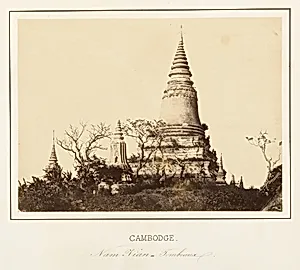
Medium
Albumen silver prints from glass negatives
Dimensions
16.6 x 22.7 cm (6 9/16 x 8 15/16 in.)
Classification
Photographs
Department
Photographs
Museum
Metropolitan Museum of Art, New York, NY
Credit
Gilman Collection, Purchase, The Horace W. Goldsmith Foundation Gift, through Joyce and Robert Menschel, 2005
Accession Number
2005.100.501 (46)
Rights
Public Domain
Tags
Art Historical Context
Émile Gsell's *Nam-Vian - Tombeaux* (1866) captures the intricate architecture of ancient tombs in what is likely a reference to Nam Viet, a historical region in southern Vietnam. This albumen silver print from a glass negative, measuring 16.6 x 22.7 cm, showcases Gsell's keen eye for monumental structures, highlighting their ornate carvings and imposing forms against lush surroundings. As part of the Photographs department at The Metropolitan Museum of Art, through the Gilman Collection in 2005, it viewers to ponder the solemn grandeur of Vietnamese funerary art. Created during the early years of French colonial presence in Indochina, the photograph reflects Gsell's role as a pioneering documentarian in Southeast Asia. Albumen silver prints, the gold standard of mid-19th-century photography, produced sharp details and warm tones from glass negatives, making them ideal for architectural studies. This medium preserved the textures of stone and the play of light on tomb surfaces with remarkable fidelity. Gsell's work holds cultural significance as one of the earliest photographic records of Vietnamese tombs, bridging Eastern traditions with Western technological innovation. These images not only preserve vanishing architectural heritage but also offer a window into a pivotal era of cultural exchange, reminding us of photography's power to immortalize history's quiet monuments.
About the Artist
Emile Gsell · 1838–1879
Emile Gsell (1838–1879) was a French photographer who became one of the earliest Western photographers to document Southeast Asia, particularly the ancient temples of Angkor in Cambodia. Born in Sainte-Marie-aux-Mines in Alsace, France, Gsell traveled to Indochina in the 1860s, establishing a photographic studio in Saigon (present-day Ho Chi Minh City) that became a base for his documentary expedi...