
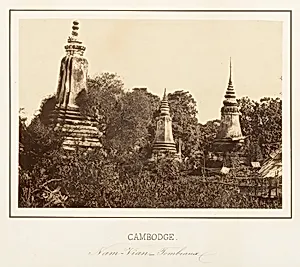
Nam-Vian - Tombeaux
1866
Medium
Albumen silver prints from glass negatives
Dimensions
15.8 x 22 cm (6 1/4 x 8 11/16 in.)
Classification
Photographs
Department
Photographs
Museum
Metropolitan Museum of Art, New York, NY
Credit
Gilman Collection, Purchase, The Horace W. Goldsmith Foundation Gift, through Joyce and Robert Menschel, 2005
Accession Number
2005.100.501 (47)
Rights
Public Domain
Tags
Art Historical Context
In 1866, French photographer Émile Gsell captured *Nam-Vian - Tombeaux*, a striking albumen silver print from glass negatives measuring 15.8 x 22 cm. This image, part of The Metropolitan Museum of Art's Gilman Collection, depicts Vietnamese tombs—likely from the Annam region (central Vietnam)—showcasing intricate architecture amid the lush tropical landscape. Gsell, one of the earliest photographers in French Indochina, documented colonial encounters with local culture during the mid-19th century, when France was expanding its influence in Southeast Asia following the conquest of Saigon in 1861. The albumen process, popular from the 1850s to 1890s, produced richly toned prints with fine detail, ideal for architectural subjects. Gsell's glass negatives allowed for precise rendering of ornate tomb structures—elaborate pagoda-like forms blending Confucian, Buddhist, and indigenous motifs—preserving a vanishing world for Western audiences. These photographs were not mere records; they bridged ethnography and artistry, fueling European fascination with "exotic" Asia. Today, *Nam-Vian - Tombeaux* highlights photography's role in colonial visual culture, offering a window into Vietnam's funerary traditions while reminding us of the era's power dynamics. A testament to Gsell's technical prowess, it invites visitors to ponder the enduring beauty of these sacred sites.
About the Artist
Emile Gsell · 1838–1879
Emile Gsell (1838–1879) was a French photographer who became one of the earliest Western photographers to document Southeast Asia, particularly the ancient temples of Angkor in Cambodia. Born in Sainte-Marie-aux-Mines in Alsace, France, Gsell traveled to Indochina in the 1860s, establishing a photographic studio in Saigon (present-day Ho Chi Minh City) that became a base for his documentary expedi...