
Napkin
c. 1600
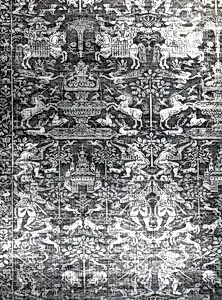
Medium
Linen, satin damask weave
Dimensions
111.5 × 72.7 cm (43 7/8 × 28 5/8 in.)
Classification
textile
Department
Textiles
Museum
Art Institute of Chicago
Accession Number
146059
Rights
Public Domain
Art Historical Context
Step into the world of 17th-century domestic luxury with this elegant *Napkin*, a finely crafted textile from around 1600, now housed in the Art Institute of Chicago's Textiles Department. Measuring 111.5 × 72.7 cm (43 7/8 × 28 5/8 in.), this substantial linen piece was likely used by the elite during elaborate meals, where table linens served as both practical necessities and displays of refinement. The standout feature is its satin damask weave, a sophisticated technique popular in Renaissance and early Baroque Europe. In damask weaving, artisans manipulated the loom to create reversible patterns: glossy satin floats contrast with matte ground weaves, producing intricate motifs—often floral or geometric—that shimmer in candlelight. Linen, prized for its durability and crispness, was ideal for such high-status items, sourced from regions like Flanders or Italy where weaving guilds excelled. Though the artist remains unknown, this napkin highlights textiles' artistic merit, bridging craft and fine art. It evokes the opulence of princely banquets, where such linens underscored social hierarchy and cultural sophistication, reminding us how everyday objects once embodied extraordinary skill.
About the Artist
Unknown
The artist designated as "Unknown" in our virtual museum's collection exemplifies a poignant chapter in art history: creators whose identities have faded into obscurity despite the enduring power of their work. With only one known artwork attributed to them in our holdings, this figure represents countless anonymous hands that shaped visual culture across centuries. Museums worldwide, including th...