
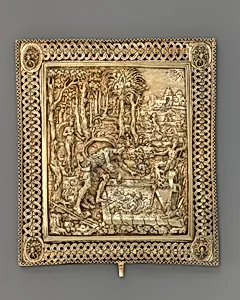
Narcissus at the Source
ca. 1600
Medium
Cast, chased, engraved and gilded silver
Dimensions
wt. confirmed: 5 7/16 × 4 13/16 in., 12.345oz. (13.8 × 12.2 cm, 350g)
Classification
Metalwork-Silver
Culture
German, Nuremburg
Department
European Sculpture and Decorative Arts
Museum
Metropolitan Museum of Art, New York, NY
Credit
Purchase, Anna-Maria and Stephen Kellen Acquisitions Fund, 2021
Accession Number
2021.118
Rights
Public Domain
Tags
About this artwork
Christoph Jamnitzer's "Narcissus at the Source" (circa 1600) represents German Renaissance goldsmithing at its most sophisticated, combining mythological narrative with virtuoso metalworking technique. Created in cast, chased, engraved, and gilded silver, this Nuremberg masterpiece (5 7/16 × 4 13/16 inches, 12.345 ounces) depicts the tragic Greek myth of Narcissus, who died gazing at his own reflection in a pool—a cautionary tale about vanity and self-love that resonated with Christian morality....
Art Historical Context
Christoph Jamnitzer’s “Narcissus at the Source,” created around 1600 in Nuremberg, captures the Greek myth of the youth who perished gazing at his own reflection. This small silver sculpture, measuring just over five inches across and weighing about twelve ounces, transforms a cautionary tale of vanity into a richly detailed object meant for close viewing. Jamnitzer, part of a celebrated family of goldsmiths whose workshop had served European nobility for generations, combined narrative drama with technical brilliance in this cast, chased, engraved, and gilded piece. The work exemplifies German Renaissance metalwork at its finest. Complex casting allowed the artist to create a three-dimensional scene, while delicate chasing and engraving added texture and depth to every surface. Gilding provided both luminous color and lasting protection. Such virtuoso objects were prized in princely kunstkammers, where mythological subjects demonstrated classical learning alongside moral instruction. Acquired by the Metropolitan Museum in 2021, the sculpture highlights Nuremberg’s role as a center of luxury craftsmanship and humanist culture at the turn of the seventeenth century.
About the Artist
Christoph Jamnitzer · 1563–1618
Comment on works: goldsmith; copper engraver