
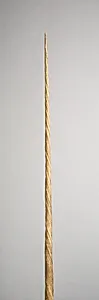
Narwhal Tusk
16th/17th century (?)
Medium
Ivory
Dimensions
H.: 233.7 cm (92 in.)
Classification
arms and armor, miscellaneous
Department
Applied Arts of Europe
Museum
Art Institute of Chicago
Accession Number
116458
Rights
Public Domain
Art Historical Context
This impressive Narwhal Tusk, nearly eight feet in length, dates to the 16th or 17th century and belongs to the Art Institute of Chicago’s Applied Arts of Europe collection. Fashioned from ivory, it is the elongated, spiraled tooth of a male narwhal, an Arctic whale whose tusks reached Europe through northern trade networks. Though the maker is unknown, such objects were prized for their rarity and striking natural form during the Renaissance and Baroque eras. In European courts and collections, narwhal ivory was valued as an exotic material that blurred the line between natural specimen and crafted artifact. Its classification among arms and armor suggests it may have served a ceremonial or symbolic role—perhaps as a staff of authority or a curiosity displayed alongside weapons and armor. The tusk’s great size and spiral texture made it a spectacular addition to cabinets of curiosities, where it embodied the period’s fascination with distant lands and the wonders of the natural world. Today the tusk stands as a testament to how European applied arts embraced both artistry and nature, transforming a remarkable biological object into a lasting emblem of prestige and wonder.
About the Artist
Unknown
The artist designated as "Unknown" in our virtual museum's collection exemplifies a poignant chapter in art history: creators whose identities have faded into obscurity despite the enduring power of their work. With only one known artwork attributed to them in our holdings, this figure represents countless anonymous hands that shaped visual culture across centuries. Museums worldwide, including th...