
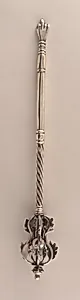
Yad
17th or 18th century
Classification
appliances & tools
Department
Smithsonian Collection
Museum
Smithsonian American Art Museum
Credit
Gift of Ruth Friedman in memory of Harry G. Friedman
Accession Number
1966-3-14
Rights
Public Domain
About this artwork
Research in Progress
Art Historical Context
This 17th- or 18th-century Yad is a ceremonial pointer essential to Jewish synagogue practice. The Hebrew word “yad” means “hand,” and these objects traditionally end in a small sculpted hand with an extended index finger. During the public reading of the Torah, the pointer allows the reader to follow the text without the human hand ever touching the sacred parchment, thereby honoring the holiness of the scroll. Although the maker of this particular Yad is unknown and its exact medium remains undocumented, objects of this type from the period typically combined practical function with decorative skill, embodying both religious devotion and artistic expression. Now in the Smithsonian American Art Museum’s collection of appliances and tools, the piece was given by Ruth Friedman in memory of Harry G. Friedman. It offers visitors a tangible link to centuries of Jewish liturgical tradition and the care communities have long taken to create beautiful, purposeful ritual objects. Research into its precise origins continues, yet its cultural meaning is already clear.
About the Artist
Unknown
The artist designated as "Unknown" in our virtual museum's collection exemplifies a poignant chapter in art history: creators whose identities have faded into obscurity despite the enduring power of their work. With only one known artwork attributed to them in our holdings, this figure represents countless anonymous hands that shaped visual culture across centuries. Museums worldwide, including th...