
Nativity
ca. 1543
Medium
Etching
Dimensions
sheet: 13 5/8 x 15 13/16 in. (34.6 x 40.2 cm)
Classification
Prints
Department
Drawings and Prints
Museum
Metropolitan Museum of Art, New York, NY
Credit
The Elisha Whittelsey Collection, The Elisha Whittelsey Fund, 1996
Accession Number
1996.8
Rights
Public Domain
Tags
Art Historical Context
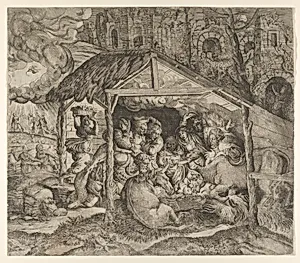
In the serene glow of this etching titled *Nativity*, created around 1543, visitors encounter a poignant scene of the Adoration of the Shepherd. Attributed to the renowned Mannerist artist Giulio Romano—pupil of Raphael and court painter to the Gonzaga dukes in Mantua—and etched by the skilled Master IQV, the print captures the humble birth of Christ amid rustic shepherds paying homage. Measuring 13 5/8 x 15 13/16 inches, its intimate scale invites close contemplation, evoking the spiritual humility central to Renaissance Nativity traditions. Etching, a relatively new technique in the 16th century, distinguished this work from traditional engravings. Unlike the rigid burin lines of engraving, etching's acid-bitten plates allowed Romano's fluid, expressive strokes—hallmarks of Mannerism with its elegant distortions and dramatic compositions. This innovative medium democratized high art, enabling affordable dissemination of sacred imagery across Europe during the Counter-Reformation era, when visual piety flourished. Housed in the Metropolitan Museum of Art's Drawings and Prints department through The Elisha Whittelsey Collection, this piece exemplifies how prints bridged elite patronage and popular devotion, blending Romano's inventive style with timeless Christian iconography for enduring inspiration.
About the Artist
Giulio Romano|Master IQV · 1499–1546
Giulio Romano (c. 1499–1546) was the most gifted pupil of Raphael and one of the founding figures of Mannerism, the style that succeeded the High Renaissance in Italy. Born Giulio Pippi in Rome, he entered Raphael's workshop as a boy and proved so talented that by the time of Raphael's death in 1520 he was effectively running the studio and overseeing the completion of major unfinished commissions...