
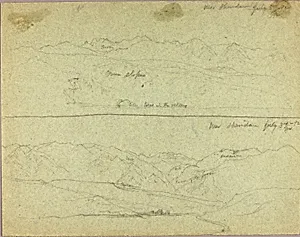
Near Sheridan, July 3rd, 1892
1892
Medium
Drawing
Classification
Drawing
Department
Smithsonian Collection
Museum
Smithsonian American Art Museum
Credit
Smithsonian American Art Museum, Gift of Dr. William Henry Holmes
Accession Number
1930.12.19
Rights
Public Domain
Tags
Art Historical Context
Thomas Moran’s “Near Sheridan, July rd, 1892” captures a fleeting summer moment in the American West through the intimate medium of drawing. Created during one of Moran’s later western travels, the work reflects his lifelong fascination with the dramatic landscapes of Wyoming and Montana. As a drawing, it offers a direct, spontaneous record of place—likely rendered on-site with pencil or watercolor—allowing viewers to sense the artist’s immediate response to light, terrain, and season. Moran, celebrated for his luminous paintings that helped establish Yellowstone National Park, brought the same reverence for nature’s grandeur to his smaller works on paper. This piece, now in the Smithsonian American Art Museum, exemplifies how 19th-century artists used drawings both as studies and as independent expressions of national identity. The precise date in the title invites us to imagine Moran sketching under the July sun, documenting a landscape that was rapidly changing with westward expansion. Gifted to the nation by Dr. William Henry Holmes, the drawing preserves a quiet yet vivid chapter of American exploration and artistic ambition. Its presence in the Smithsonian collection reminds visitors of the vital role drawings played in shaping public appreciation for the American wilderness.
About the Artist
Thomas Moran · 1837–1926
Thomas Moran (1837–1926) was an American painter and printmaker of the Hudson River School whose dramatic paintings of the American West played a pivotal role in the creation of the national parks. Born in Bolton, Lancashire, England, he emigrated with his family to Philadelphia as a child. He was largely self-taught, though he apprenticed briefly with a wood engraver and studied the work of J.M.W...