
Neck Ring
Unknown Artist
400–300 BC
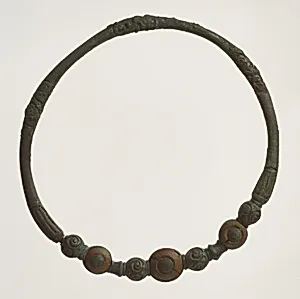
Medium
Copper alloy with remains of glass paste inlays
Dimensions
Overall: 5 15/16 x 5 7/8 x 3/4 in., 0.377lb. (15.1 x 14.9 x 1.9 cm, 171g)
Classification
Metalwork-Copper alloy
Culture
Celtic
Department
Medieval Art
Museum
Metropolitan Museum of Art, New York, NY
Credit
Gift of J. Pierpont Morgan, 1917
Accession Number
17.194.1919
Rights
Public Domain
Art Historical Context
This exquisite Neck Ring, crafted by an unknown Celtic artist around 400–300 BC, exemplifies the masterful metalworking of Iron Age Europe. Measuring just under 6 inches in diameter and weighing a modest 0.377 pounds, it likely worn as a torque—a rigid collar symbolizing status, wealth, or tribal affiliation among Celtic warriors and elites. Housed in the Metropolitan Museum of Art's Medieval Department (gift of J. Pierpont, 1917), it bridges ancient craftsmanship with enduring cultural legacy. Forged from copper alloy, the ring features traces of vibrant glass paste inlays, a technique highlighting the Celts' advanced skills in alloying metals and embedding colorful materials for dramatic effect. These inlays would have originally gleamed with reds, blues, or greens, catching the light during rituals or daily wear. Such metalwork reflects the La Tène style's emerging complexity, though specific motifs are not detailed here. For visitors, this artifact offers a tangible glimpse into Celtic society, where jewelry like this neck ring served not just as adornment but as a badge of identity and power—reminding us of a vibrant culture that influenced much of prehistoric Europe.