
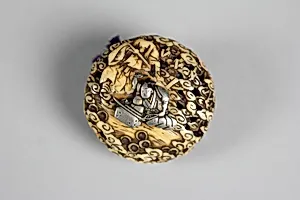
Netsuke of Munechika Forging Blade "Little Fox"
Unknown Artist
19th century
Medium
Ivory with silver insert
Dimensions
H. 1 in. (2.5 cm); Diam. 1 3/4 in. (4.4 cm)
Classification
Netsuke
Culture & Period
Japan · Edo (1615–1868) or Meiji period (1868–1912)
Department
Asian Art
Museum
Metropolitan Museum of Art, New York, NY
Credit
Gift of Mrs. Russell Sage, 1910
Accession Number
10.211.1203
Rights
Public Domain
Tags
Art Historical Context
This exquisite netsuke, titled *Munechika Forging Blade " Fox,"* captures a pivotal moment in Japanese swordsmithing legend. Carved in the 19th century during Japan's Edo (1615–1868) or early Meiji (1868–1912) period, it depicts the renowned swordsmith Munechika work hammering his famous blade, Kogitsune-maruLittle Fox"), one of Japan's earliest legendary swords. At just 1 inch high and 1¾ inches in diameter, this ivory sculpture with a silver insert exemplifies the miniaturist's art, where every chisel mark conveys intense focus and craftsmanship. Netsuke like this one served a practical yet artistic purpose in traditional Japanese dress. Worn as toggles on inro (small lacquered cases for medicines or seals) attached to kimono sashes, they prevented pouches from slipping. By the 19th century, netsuke had evolved into collectible sculptures, showcasing virtuoso carving skills on ivory—a prized material for its creamy texture and ability to hold fine details, like the subtle silver inlay enhancing metallic gleam or eyes. Housed in the Metropolitan Museum of Art's Asian Art Department since 1910, this piece highlights Japan's enduring fascination with samurai lore and artisanal precision. Its tags—men and tools—evoke the era's reverence for master craftsmen, inviting visitors to marvel at how such a tiny object bridges utility, myth, and beauty.