
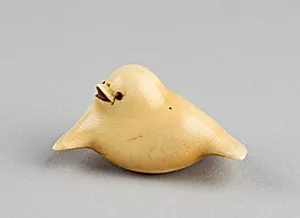
Netsuke of Young Sparrow
Unknown Artist
19th century
Medium
Ivory
Dimensions
H. 7/8 in. (2.2 cm); W. 1 1/2 in. (3.8 cm); D. 1 in. (2.5 cm)
Classification
Netsuke
Culture & Period
Japan · Edo (1615–1868) or Meiji period (1868–1912)
Department
Asian Art
Museum
Metropolitan Museum of Art, New York, NY
Credit
Edward C. Moore Collection, Bequest of Edward C. Moore, 1891
Accession Number
91.1.967
Rights
Public Domain
Tags
Art Historical Context
Nestled in the Metropolitan Museum of Art's Art collection, this exquisiteNetsuke of Young Sparrow* is a 19th-century Japanese carving from the Edo (1615–1868) or earlyiji (1868–1912) period. Measuring just 7/8 inches high, 1 1/2 inches wide, 1 inch deep, its diminutive scale belies the artisan's extraordinary skill in capturing the delicate fluff and alert gaze of a fledgling bird perched as if ready to take flight. Part of the Edward C. Moore Collection, bequeathed in 1891, it exemplifies the intricate pocket sculptures prized by collectors worldwide. Netsuke originated as practical toggles for securing inro (small medicine boxes) or tobacco pouches to a samurai's sash, evolving into wearable art during Japan's Edo era of peace and prosperity. Carved from ivory—valued for its smooth, luminous quality that mimics life-like feathers and subtle textures—this piece highlights the unnamed artist's prowess in himoto-me (cord holes) and realistic animal depiction, a hallmark of netsuke craftsmanship. Birds like the sparrow often symbolized everyday joys or seasonal change in Japanese culture, blending utility with poetic whimsy. Though tiny, this netsuke invites wonder at Japan's artistic ingenuity, bridging functionality and fine art in a pre-industrial age. Visitors, imagine it dangling from a kimono, a feathered charm amid bustling Edo streets!