
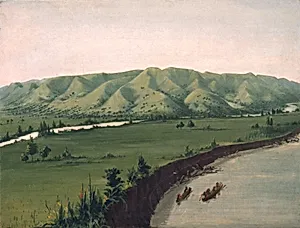
Nishnabottana Bluffs, 1070 Miles above St. Louis
1832
Medium
Painting
Classification
Painting
Department
Smithsonian Collection
Museum
Smithsonian American Art Museum
Credit
Smithsonian American Art Museum, Gift of Mrs. Joseph Harrison, Jr.
Accession Number
1985.66.385
Rights
Public Domain
Tags
About this artwork
George Catlin journeyed up the Missouri River in 1832. “I often landed my skiff,” he recalled, “and mounted the green carpeted bluffs whose soft grassy tops, invited me to recline, where I was at once lost in contemplation. Soul melting scenery that was about me! A place where the mind could think volumes; but the tongue must be silent that would speak, and the hand palsied that would write.” (Catlin, Letters and Notes, vol. 2, no. 32, 1841; reprint 1973)
Art Historical Context
**Nishnabottana Bl, 1070 Miles St. Louis** George Catlin, 1832, Oil on canvas* In 1832, pioneering George Catlin embarked on epic journey up the Missouri River, the untamed American West through his vivid paintings. This work captures the majestic Nishnabottana Bl—towering, grass-carpeted formations located about 1,070 miles from St Louis—during his travels aboard the steamboat *Yellow Stone*. As a key figure in 19th-century American art, Catlin sought to preserve the rapidly vanishing landscapes and cultures of the frontier before industrialization and westward expansion transformed them forever. Catlin's own words bring the scene to life: "I often landed my skiff... and mounted the green carpeted bluffs whose soft grassy tops, invited me to recline, where I was at once lost in contemplation. Soul melting scenery that was about me!" His painting evokes this profound serenity, rendering the bluffs' undulating forms against expansive skies in his characteristic realistic style, blending Romantic awe with documentary precision. Now in the Smithsonian American Art Museum (gift of Mrs. Joseph, Jr.), it stands as a testament to the West's pristine beauty. This piece highlights Catlin's broader mission chronicle Native American life and wilderness, offering visitors a window into a contemplative moment amid America's wild heart. (198 words)
About the Artist
George Catlin · 1796–1872
George Catlin (1796–1872), born in Wilkes-Barre, Pennsylvania, to Putnam Catlin and Polly Sutton—who had been captured by Native Americans during the 1778 Battle of Wyoming—initially pursued a legal career. Trained at Litchfield Law School, he was admitted to the bar in 1819 but abandoned law after two years to study art in Philadelphia in 1823. Self-taught as a portraitist, Catlin quickly gained ...