
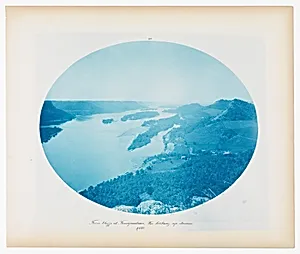
No. 90. From bluffs at Trempealueau, Wisconsin Looking Up Stream
1885
Medium
Cyanotype
Dimensions
Sheet: 14 1/2 × 17 3/16 in. (36.8 × 43.7 cm)
Classification
Photographs
Department
Photographs
Museum
Metropolitan Museum of Art, New York, NY
Credit
Gift of Charles Wehrenberg and Sally Larsen, 2014
Accession Number
2014.715.6
Rights
Public Domain
Tags
Art Historical Context
Henry P. Bosse's *No. 90. From bluffs at Tremaleau, Wisconsin Looking Up Stream* (1885) captures the dramatic sweep of the Upper Mississippi River elevated bluffs in Trempealeau,. As a pioneering photographer for the U.S. Army of Engineers, Bosse the river's rugged landscapes during a time of rapid American expansion and infrastructure development in the late 19th century. cyanotype offers visitors a vivid glimpse into the untamed natural beauty of the Midwest, where winding waters meet steep bluffs, evoking the era's awe-inspiring frontier spirit. The artwork's medium—a cyanotype—adds to its allure. This early photographic process, invented in 1842, produces striking Prussian blue prints through exposure to sunlight, making it ideal for outdoor documentation. Bosse favored cyanotypes for their affordability, durability, and ability to render expansive vistas with crisp detail, as seen in the 14 1/2 × 17 3/16 in. sheet. Unlike albumen prints, cyanotypes were contact prints, directly scaling the negative to the final image, which preserved the scene's monumental scale. Housed in the Metropolitan Museum of Art's Photographs Department (gift of Charles Wehrenberg and Sally Larsen, 2014), this piece highlights photography's role in scientific surveying and artistic landscape tradition. It bridges engineering precision with poetic interpretation, inviting modern viewers to ponder the Mississippi's enduring majesty.
About the Artist
Henry P. Bosse · 1844–1893
Henry Peter Bosse was born in 1844 in Sonneberg, Prussia (now Germany), and immigrated to the United States around 1870. He settled in the Midwest and joined the U.S. Army Corps of Engineers in 1874 as a draftsman. By the mid-1880s he had risen to chief draftsman in the Rock Island, Illinois, district, where he remained for the rest of his career. His dual expertise in engineering and visual docum...