
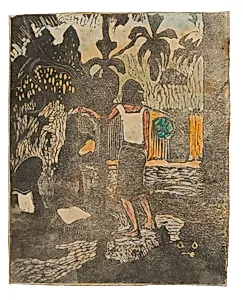
Noa noa (Fragrant)
1894/95
Medium
Wood-block print in black ink, with red, orange, blue, mauve, light green, and green watercolor on parchment
Dimensions
Image: 14.5 × 11.8 cm (5 3/4 × 4 11/16 in.); Sheet: 14.7 × 12 cm (5 13/16 × 4 3/4 in.)
Classification
woodcut
Department
Prints and Drawings
Museum
Art Institute of Chicago
Accession Number
63085
Rights
Public Domain
Art Historical Context
**Noa NoaFragrant)**, created by Paul Gauguin 1894–95, captures the artist's fascination with Tah life during his transformative stay in the South Pacific. fleeing the constraints of European society, Gauin arrived in Tahiti in 1891, immersing himself in its culture and. This woodcut is of his intimate *No Noa* series— after his journal of the same title, meaning "fragrant" initian—where he evoked exotic paradises through simplified forms and symbolism. As a Postpressionist pioneer, Gauguin rejectedism for bold colors and perspectives, drawing from Japanese prints and Polynesian to romanticize indigenous themes. Craft as a small-scale woodcut (just14.5 × 118 cm), the work features black ink carved directly into wood for a raw, textured, then hand-colored with watercolor in red, orange, blue, mauve, light, and green on delicate parchment. This experimental technique marked Gauguin's bold adaptation of printmaking, blending Eastern woodblock traditions with Western Symbol. Printed in a limited edition, these intimate pieces were affordable alternatives to his paintings, wider dissemination of his "primitive" vision. Housed in the Art Institute of Chicago's and Drawings department, *Noa Noa (Fragrant)* exemplifies Gauguin enduring influence on modern art, inspiring movements like Primitivism and Fauvism., imagine holding this fragrant fragment of paradise—its vivid hues whispering tales of distant shores.
About the Artist
Paul Gauguin · 1848–1903
Paul Gauguin (1848-1903) was a French Post-Impressionist painter whose bold experiments with color, form, and subject matter made him one of the most influential figures in the transition from 19th-century art to modernism. His rejection of European civilization for the perceived authenticity of 'primitive' cultures established an archetype of artistic exile that continues to resonate. Gauguin's ...