
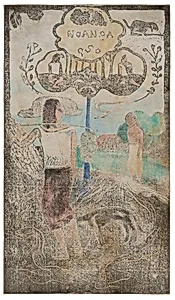
Noa Noa (Fragrant), from the Noa Noa Suite
1893/94
Medium
Wood-block print in black ink, over traces of brown ink, with hand-applied blue, light blue, several greens, pink, orange, pale-orange, yellow, pale-red, and dark-gray watercolor, on ivory Japanese paper
Dimensions
Image: 35.4 × 20.3 cm (13 15/16 × 8 in.); Sheet: 35.7 × 20.6 cm (14 1/16 × 8 1/8 in.)
Classification
woodcut
Department
Prints and Drawings
Museum
Art Institute of Chicago
Accession Number
63019
Rights
Public Domain
Art Historical Context
**Noa Noa (Fragrant), from the No Noa Suite** Paul Gauguin, 1893/94* Paul Gauguin created this captivating woodcut during and shortly after his transformative first journey to Tahiti in 3–94. Seeking escape from European industrialization, the Post-Impressionist artist immersed in Polynesian culture, which profoundly shaped his vision of an idyllic, primal paradise. "Noaa," meaning "fragrant" in Tahitian, evokes the scents and sensuality of the islands, drawing from Gauguin's personal journal of the same name. As part of his rare Noa Noa Suite—a series of just 10 or so prints—this piece captures his fascination with exotic beauty and spiritual harmony. Crafted as a wood-block print in black ink over traces of brown, the work is vibrantly hand-colored with watercolor washes in blues, greens, pinks, oranges, yellows, and grays on luxurious ivory Japanese paper (35.4 × 20.3 cm). Gauguin's rough, gouged lines and bold color application marked a bold departure from refined Japanese ukiyo-e prints that inspired him, pioneering a Western approach to color woodcuts with raw, expressive energy. This experimental technique highlighted his Symbolist tendencies, blending reality and dreamlike reverie. Housed in the Art Institute of Chicago's Prints and Drawings department, *Noa Noa (Fragrant)* exemplifies Gauguin's influence on modern art, bridging Primitivism and Fauvism while romanticizing Tahitian life for Western audiences. A window into his exotic quest, it invites visitors to ponder the allure of distant horizons.
About the Artist
Paul Gauguin · 1848–1903
Paul Gauguin (1848-1903) was a French Post-Impressionist painter whose bold experiments with color, form, and subject matter made him one of the most influential figures in the transition from 19th-century art to modernism. His rejection of European civilization for the perceived authenticity of 'primitive' cultures established an archetype of artistic exile that continues to resonate. Gauguin's ...