
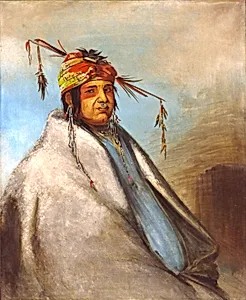
Non-on-dá-gon, a Chief
1830
Medium
Painting
Classification
Painting
Department
Smithsonian Collection
Museum
Smithsonian American Art Museum
Credit
Smithsonian American Art Museum, Gift of Mrs. Joseph Harrison, Jr.
Accession Number
1985.66.276
Rights
Public Domain
Tags
About this artwork
George Catlin probably took portraits of Delaware/Lenape chiefs Non-on-dá-gon and the Answer (see 1985.66.275) at Fort Leavenworth (in today’s Kansas) in 1830. Catlin wrote at length of these images: “Non-on-dá-gon, with a silver ring in his nose, is another of the chiefs of distinction, whose history I admired very much . . . In both of these . . . [portraits] their dresses were principally of stuffs of civilized manufacture; and their heads were bound with vari-coloured handkerchiefs or shawls...
Art Historical Context
**Non-on-dá-gon, a Chief** by George Catlin (1830) captures the dignified likeness of a distinguished Delaware/Lenape chief, painted during Catlin's travels among Native American tribes in the early 19th century. Catlin, a pioneering artist and ethnographer, dedicated his career to documenting Indigenous peoples through realistic oil portraits, creating an invaluable visual record before widespread displacement. This work, now in the Smithsonian American Art Museum, exemplifies his commitment to authenticity, portraying Non-on-dá-gon at Fort Leavenworth in present-day Kansas. In his own words from *Letters and Notes* (1841), Catlin described the chief's striking features: a silver ring in his nose and a head bound with a colorful handkerchief or shawl, styled like a "Turkish turban." Non-on-dá-gon's attire blended traditional elements with "stuffs of civilized manufacture," reflecting the cultural exchanges and pressures of the era amid U.S. expansion and the Indian Removal policies. This portrait holds profound historical and cultural significance, offering a rare glimpse into Delaware/Lenape leadership during a turbulent time. Catlin's meticulous technique preserved not just faces, but stories of resilience, inviting visitors to appreciate the humanity and heritage of Native nations. (198 words)
About the Artist
George Catlin · 1796–1872
George Catlin (1796–1872), born in Wilkes-Barre, Pennsylvania, to Putnam Catlin and Polly Sutton—who had been captured by Native Americans during the 1778 Battle of Wyoming—initially pursued a legal career. Trained at Litchfield Law School, he was admitted to the bar in 1819 but abandoned law after two years to study art in Philadelphia in 1823. Self-taught as a portraitist, Catlin quickly gained ...