
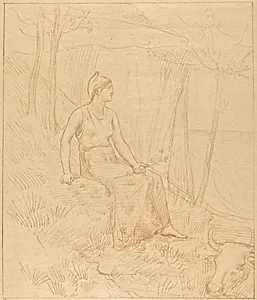
Normandie (Normandy)
Medium
lithograph in printed in brown on Japan paper
Dimensions
image: 46.3 × 39.2 cm (18 1/4 × 15 7/16 in.) sheet: 55.3 × 43.6 cm (21 3/4 × 17 3/16 in.)
Classification
Department
CG-E
Museum
National Gallery of Art, Washington, D.C.
Credit
Rosenwald Collection
Accession Number
1946.21.154
Rights
Public Domain
Art Historical Context
**Normandie (Normandy)**, a captivating 1893 lithograph by Pierre Puvis de Chavannes, invites visitors to explore the poetic essence of France's Normandy region. Printed in soft brown ink on fine Japan paper—a luxurious, thin sheet prized for its absorbency and subtle texture—this work measures 46.3 × 39.2 cm (image) and exemplifies late 19th-century printmaking elegance. Housed in the National Gallery of Art's Rosenwald Collection (Department CG-E), it reflects Puvis's mastery in translating his vision to a reproducible medium. Puvis de Chavannes (1824–1898), a pivotal French Symbolist, was renowned for his dreamlike murals blending classical idealism with mystical themes. His style emphasized serene, allegorical figures against simplified landscapes, evoking timeless harmony. In *Normandie*, this approach likely personifies the region's rugged coasts and pastoral charm, a nod to French regional pride during the fin-de-siècle era of national identity and artistic revival. Lithography's planar technique suited Puvis's fluid lines and tonal gradations, allowing broad dissemination of his elite mural aesthetics. This print not only highlights technical innovation—brown ink creating warm, monochromatic depth—but also cultural significance, bridging fine art and popular appreciation in an age of expanding print culture. A quiet gem for contemplating France's soul. (198 words)
About the Artist
Pierre Puvis de Chavannes · 1824–1898
Pierre Puvis de Chavannes (1824–1898) was a French painter who became the foremost muralist of nineteenth-century France and a crucial bridge between academic tradition and modernism. Born in Lyon to a prosperous family, he studied briefly with Henri Scheffer and Thomas Couture in Paris and traveled to Italy, where the frescoes of the Italian Renaissance made a lasting impression on his artistic v...