
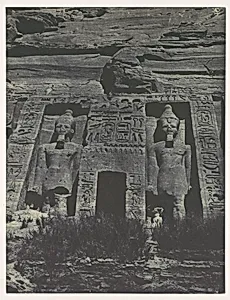
Nubie. Ibsamboul. Entrée du Spéos d'Hathor
Medium
Salted paper print (Blanquart-Évrard process) from paper negative
Dimensions
Frame: 20 x 16 in. (50.8 x 40.6 cm)
Classification
Photographs
Department
Photographs
Museum
Metropolitan Museum of Art, New York, NY
Credit
Robert O. Dougan Collection, Gift of Warner Communications Inc., 1981
Accession Number
1981.1229.6.22
Rights
Public Domain
Tags
Art Historical Context
Step into the sun-baked grandeur of ancient Nubia with *Nubie. Ibsamboul. Entrée du Spéos d'Hathor*, a pioneering salted paper print captured by Maxime Du Camp on March28, 1850. This evocative photograph frames the monumental entrance to the Speos of Hathor at Abu Simbel, a rock-cut temple from Ramses II's reign (c. 1264–1247 BCE). Towering figures of the pharaoh and intricate hieroglyphs adorn the facade, with human figures—likely local men—adding a touch of lived history to the eternal stone. Du Camp, a French writer and early photographer, documented Egypt's wonders during his 1849–1850 journey with Gustave Flaubert, producing one of the first extensive photographic records of ancient sites. Printed using Louis-Désiré Blanquart-Évrard's innovative process at his Lille studio, this salt print from a paper negative offered rich tonal warmth and durability, revolutionizing archaeological documentation before modern techniques. Housed in The Metropolitan Museum of Art's Robert O. Dougan Collection, this 20 x 16-inch work bridges 19th-century exploration with Egypt's timeless legacy, inviting us to ponder the pharaohs through a lens that captured light and shadow with groundbreaking fidelity.
About the Artist
Maxime Du Camp|Imprimerie photographique de Blanquart-Évrard, à Lille · 1822–present
Maxime Du Camp (1822–1894) was a pioneering French photographer and writer whose adventurous spirit and technical innovation bridged literature and visual art during the mid-19th century. Born in Paris on February 8, 1822, to a prosperous family—his father a successful surgeon—Du Camp received a solid bourgeois education at the Collège Bourbon (now Lycée Condorcet), where he cultivated interests i...